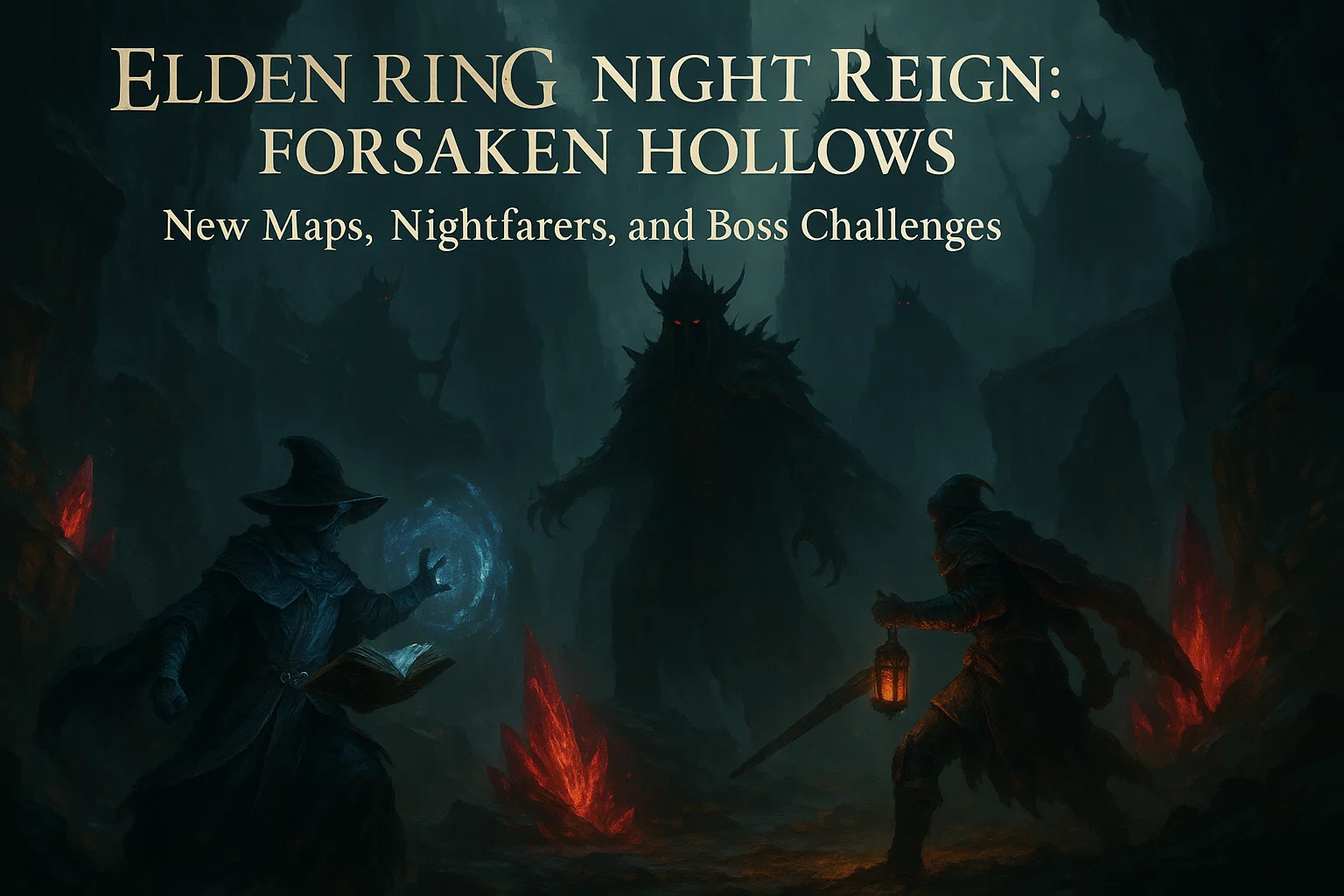
When Elden Ring Night Reign was first revealed, it felt like a wild experiment. A FromSoftware title built around multiplayer, hero-style characters, and roguelike survival mechanics did not sound real on paper, especially when tied to the Elden Ring universe. Yet against all odds, Night Reign landed as one of the most interesting spin-offs the studio has ever produced. After spending serious time with both the base game and the Forsaken Hollows DLC, I find myself impressed, conflicted, and a little frustrated all at once.
This DLC adds some genuinely great content, but it also highlights missed opportunities that stop Night Reign from becoming something truly long-lasting.
A Strong Foundation That Still Holds Up
At its core, Night Reign works because Elden Ring’s combat system is already rock solid. The enemies hit hard, bosses demand respect, and even familiar encounters feel tense when layered into a roguelike structure. For a lower-priced title, the base game delivered surprising value with eight Nightfarers, eight Night Lords, and enough replayability to keep players busy for dozens or even hundreds of hours.
Progression still feels satisfying, especially when a good run lines up and rewards you with solid relics and gear. Managing your build, coordinating with teammates, and squeezing value out of limited time during a run all feel great. Even grinding resources like elden ring runes never feels completely pointless, because each run contributes something meaningful to your overall growth.
That said, the cracks start to show once you push deep into the game.
The Roguelike Problem: Variety Runs Thin
The biggest long-term issue with Night Reign is variety. While the game is technically procedural, experienced players will quickly notice how often the same world seeds repeat. Points of interest, boss paths, and enemy combinations start to blur together after enough runs.
This goes against the core idea of a roguelike. Instead of feeling surprised, you begin planning around familiar patterns. Multiplayer helps soften this issue, since each group approaches runs differently, but repetition eventually catches up. This was already a known weakness in the base game, so expectations for the DLC were high.
What Forsaken Hollows Gets Right
Forsaken Hollows does deliver in several important ways. The two new Nightfarers, Scholar and Undertaker, add meaningful options to team composition. Scholar is powerful in the right hands, though clearly not for everyone. Undertaker, on the other hand, feels like an instant fan favorite. His playstyle fits Night Reign perfectly and adds a refreshing sense of momentum to fights.
The new Night Lords are another highlight. Both bosses feel well-designed, challenging, and memorable, standing comfortably alongside the best encounters in the game. From a pure combat perspective, the DLC is absolutely worth experiencing.
The biggest win, however, is the new shifting area known as the Great Hollow.
The Great Hollow: A Glimpse of What Could Have Been
The Great Hollow is not just a reskin of existing areas. It is a genuinely new map with vertical design, unique traversal challenges, and a different flow compared to Limveld. Breaking crystals to lift curses and unlock high-value areas changes how you approach runs and forces smarter route planning.
This is exactly the kind of content Night Reign needed. It proves the game can evolve in interesting ways without abandoning its core identity. Unfortunately, access to the Great Hollow is limited to specific DLC expeditions, which hurts its impact.
Integration Issues Hold the DLC Back
The main problem with Forsaken Hollows is not what it includes, but what it fails to change. Most of the new systems, locations, and points of interest are locked to DLC runs. They do not meaningfully affect the base game loop, even for veteran players who have already seen everything.
The absence of new weapons is especially disappointing. Shadow of the Erdtree introduced many creative weapon designs that could have completely refreshed Night Reign’s meta. Instead, players fight new enemies without ever wielding new tools. Considering how much weapons influence playstyle, this feels like a missed opportunity that no amount of balance tweaking can fix.
For players who enjoy optimizing builds and experimenting, the lack of weapon variety also limits long-term goals beyond collecting relics or farming elden ring runes for marginal gains. Some players even turn to third-party communities and services like U4GM just to speed up progression, which says a lot about how starved the game feels for meaningful rewards at the endgame.
Endgame Without Rewards
Modes like Deep of Night offer serious challenge, but almost no tangible rewards. Clearing the hardest content should feel special, yet the payoff is mostly cosmetic or symbolic. A few smart reward choices could have dramatically improved player motivation without unbalancing the game.
This lack of incentives carries over into the DLC. Once you defeat the new bosses and try out the new Nightfarers, there is little reason to keep pushing unless you simply enjoy the gameplay for its own sake.
Forsaken Hollows is a good DLC attached to a great game that never fully reaches its potential. The new characters, bosses, and map show real creativity and care, but weak integration and missing systems prevent it from transforming the overall experience.
Night Reign remains one of the most enjoyable and experimental FromSoftware projects in recent years. Even now, it is easy to imagine how incredible it could have been with more resources and long-term support. What we have is still worth playing, especially for fans of the base game, but it also stands as a reminder that strong ideas need strong follow-through.
How to Earn Fast: Elden Ring: Nightreign Hands-on Experience
