Objective control is rarely decided by firepower alone. Holding a Hardpoint or defending a Domination flag often requires players to manage exposed angles, anticipate enemy pushes, and make the most of available cover. In Call of Duty: Modern Warfare 4, the Riot Shield adds another defensive option through its Field Upgrade role. Rather than occupying a permanent primary weapon slot, it can be deployed when a team needs additional protection around an important position. This defensive approach also offers an interesting way to examine positioning and objective control in different multiplayer environments, including CoD MW4 Bot Lobbies, where players can explore how equipment choices influence their approach to contested areas.
A Different Approach to Holding Objectives
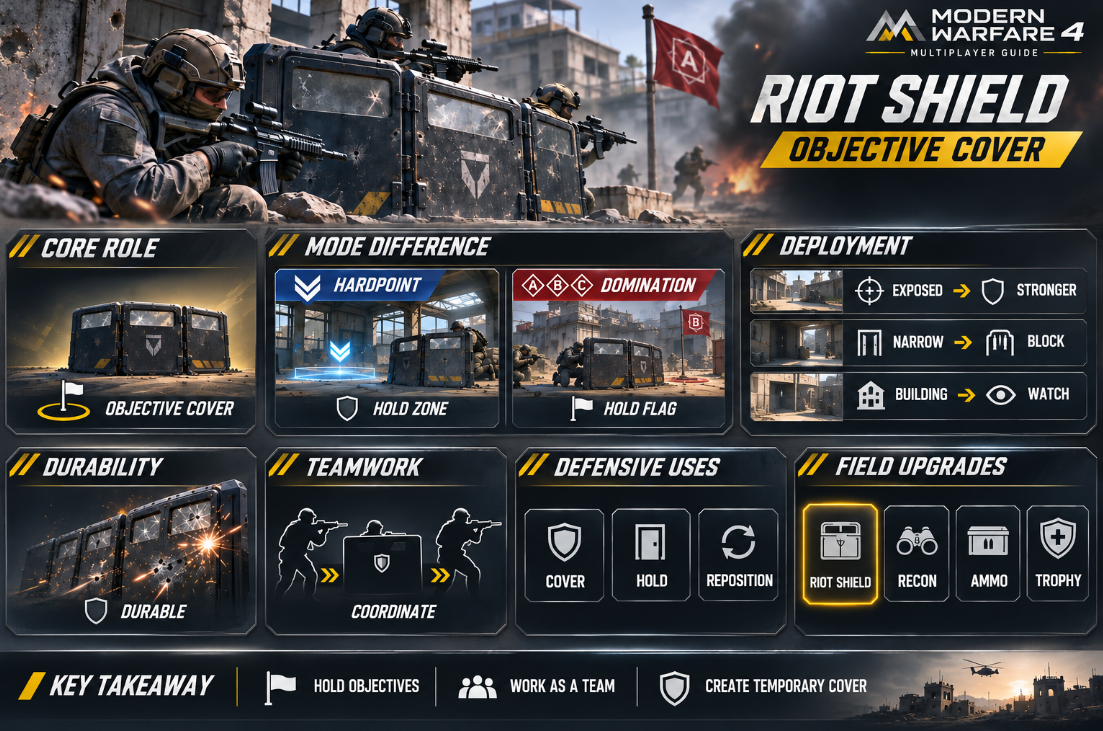
The most noticeable change is the ability to create temporary cover where the map does not provide enough protection. Once deployed, the Riot Shield gives teammates additional cover, allowing them to hold defensive positions while watching incoming approaches. This can be particularly useful around exposed objectives, where defenders would otherwise have to rely on limited environmental cover.
Its value lies in giving teams more control over their defensive setup. A wall or building offers permanent protection, but its position is determined by the map. The Riot Shield introduces some flexibility, allowing players to reinforce a vulnerable angle according to the situation. It does not make a capture point invulnerable, but it can make an enemy push more difficult by forcing attackers to reconsider their approach.
How the Shield Influences Different Game Modes
The Riot Shield has different applications depending on the objective structure of a match. Hardpoint and Domination both reward map control, but the pressure placed on defenders is not quite the same.
In Hardpoint, teams must repeatedly fight for control of a changing location. A deployed shield can help protect one side of the current objective, giving teammates more time to watch other entrances. This is especially useful when opponents are attempting to break an established defensive formation just before the next rotation. However, defenders still need to prepare for attacks from uncovered directions rather than concentrating everyone behind the same barrier.
Domination requires a broader approach because multiple flags can remain contested simultaneously. A shield placed near a vulnerable capture point may help a squad maintain its position while teammates monitor nearby routes. The main challenge is avoiding excessive commitment to one flag. Protecting a single location means little if opponents gain control elsewhere, so the equipment works best as part of a balanced map-control strategy.
Choosing the Right Deployment Position
Placement can determine whether the shield strengthens a defensive position or creates an unnecessary obstacle. A useful deployment should protect an important approach while leaving enough space for teammates to move, aim, and respond to threats.
Different situations call for different uses:
- Exposed objectives: Temporary cover can help defenders withstand incoming pressure while contesting a capture area.
- Narrow corridors: A barrier can reinforce a limited entrance and make a direct push more difficult.
- Building approaches: Positioning the shield near an entrance can give teammates a safer position from which to monitor movement.
- Changing defensive positions: The barrier can provide temporary protection while the squad adjusts its formation.
The surrounding sightlines matter just as much as the shield itself. Blocking a useful firing lane or leaving an alternative entrance unattended can undermine the entire setup. Players should consider how the barrier interacts with existing cover before committing to a position.
Durability Gives Attackers a Way to Respond
The shield’s destructible durability is an important part of its balance. It provides temporary protection rather than an unlimited defensive advantage, meaning that attackers can eventually break through a fortified position with sustained pressure.
This creates a decision point for defenders. Once the barrier begins taking significant damage, remaining behind it may become increasingly risky. Players need to recognize when their position is losing its effectiveness and prepare to move before the protection disappears.
Attackers, meanwhile, do not always need to challenge the shield directly. They can apply coordinated pressure, look for alternative routes, or force defenders to divide their attention. This makes the equipment part of an ongoing tactical exchange rather than a simple obstacle that automatically stops an advancing team.
Team Coordination Makes the Difference
A deployed shield is more effective when each squad member has a clear responsibility. The player placing the barrier establishes a defensive position, while teammates cover different approaches and watch for flanking attempts. This arrangement reduces the risk of everyone focusing on the same entrance.
Communication also helps defenders recognize when the situation is changing. An opponent preparing a coordinated push, a damaged barrier, or an uncovered route may require an immediate adjustment. Teams that react quickly can preserve their formation without becoming overly dependent on a single defensive position.
| Defensive situation | Riot Shield’s role | Main consideration |
|---|---|---|
| Exposed Hardpoint | Creates temporary cover | Watch alternative entrances |
| Domination flag defense | Protects a vulnerable approach | Maintain control of other flags |
| Narrow corridor | Reinforces a limited entry point | Watch for flanking routes |
| Team repositioning | Provides temporary protection | Move before the barrier is destroyed |
The table highlights an important distinction: the shield supports a team’s formation, but it does not replace the responsibilities of individual players. Defenders still need to monitor the map, communicate enemy movements, and adjust their positions as the match develops.
Balancing the Shield With Other Field Upgrades
The Riot Shield will not necessarily suit every team or game mode. Its defensive capabilities make it appealing when players expect to hold a fixed position, but other Field Upgrades may offer more value when a squad needs reconnaissance, ammunition support, or protection against particular threats.
The choice should reflect the team’s preferred approach. A squad that regularly defends concentrated objectives may benefit from deployable cover, while players who spend more time rotating between locations may prefer an upgrade that better supports movement or information gathering.
There is also a difference between selecting equipment for its general usefulness and choosing it for a specific match. Map layout, objective placement, and the opposing team’s behavior can all influence whether the Riot Shield is worth deploying. Treating every engagement the same way can limit its effectiveness, particularly when the team needs to change its strategy halfway through a match.
What the Riot Shield Means for Objective-Based Multiplayer
The Riot Shield adds a more flexible defensive option to Modern Warfare 4’s objective-based gameplay. Its deployable cover can help squads reinforce exposed positions, while its limited durability ensures that attacking teams still have ways to challenge established defenses. Rather than changing the fundamentals of Hardpoint or Domination, it gives players another tool for managing the pressure that comes with holding important areas.
The wider multiplayer experience also continues to develop through equipment adjustments, gameplay updates, and new content. Alongside tactical discussions, players following CoD MW4 Redeem Codes may also be interested in available in-game rewards and content updates. Nevertheless, the Riot Shield’s importance comes down to how effectively a squad uses it during contested objectives. Its greatest value lies in supporting a coordinated defensive formation without sacrificing awareness of the rest of the battlefield.